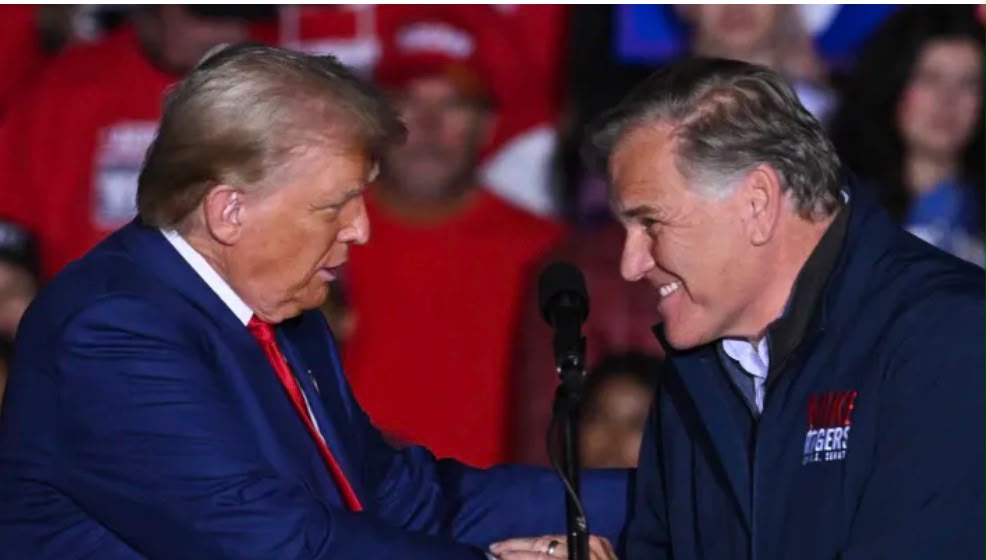
Republican US Senate candidate Mike Rogers is distancing himself from President Donald Trump on trade tariffs and the war in Iran as economic concerns become increasingly prominent in Michigan's closely contested Senate race.
According to a CNBC analysis published on Wednesday, October 14, the Michigan Republican has shifted his public messaging on two major issues previously associated with Trump's policies, as candidates prepare for the November midterm elections.
In a campaign advertisement released on October 7, Rogers declared that Canada was not Michigan's enemy and called for an immediate end to the tariff dispute between Washington and Ottawa. He did not directly mention Trump, who introduced the tariffs.
The position marked a departure from his earlier statements. In August, Rogers described the tariffs as necessary, while in September he defended Trump's America First trade agenda.
Michigan's economic ties with Canada have made the dispute particularly sensitive. According to the figures cited in the report, the state conducts approximately $80 billion in annual trade with Ontario, while Canada accounts for about 39 per cent of Michigan's exports.
The dispute has also affected the automotive industry, a major component of Michigan's economy. The Detroit Three automakers reportedly incurred about $6.5 billion in combined tariff-related costs in 2025.
Washington imposed 50 per cent tariffs on approximately $20 billion worth of Canadian goods in August following the breakdown of trade negotiations, prompting retaliatory measures from Ottawa. The administration of Democratic Governor Gretchen Whitmer has estimated that tariffs cost the average Michigan household about $1,000 annually.
Polling figures cited in the CNBC analysis indicate substantial opposition to the tariffs among Michigan voters. A Glengariff Group survey conducted in early September found that 64.2 per cent of likely voters opposed the Canadian tariffs.
A separate Emerson College survey found that 55 per cent disapproved of Trump's performance, while 47 per cent identified the economy as their leading concern.
Rogers has also shifted his rhetoric on the war in Iran. After initially supporting military action, he called for the conflict to end quickly as energy costs rose. Michigan's highway diesel prices reportedly reached $6.71 per gallon in September.
The trend extends beyond Michigan. CNBC's analysis found that 57 of 1,324 Republican general-election advertisements, representing 4.3 per cent, mentioned Trump, compared with 47.1 per cent of Republican primary advertisements. Democratic general-election advertisements mentioned him in 20.9 per cent of cases.
The Michigan contest remains closely watched as both parties seek to secure control of the Senate. The Cook Political Report rates the race a toss-up, while the polling average cited in the report gives Democratic candidate Abdul El-Sayed a four-point lead.
Republicans maintain a financial advantage in congressional advertising, reportedly outspending Democrats by approximately $200 million in September.
Rogers has also sought to shift attention towards transgender-related issues, which account for about one in nine advertisements from his campaign and the National Republican Senatorial Committee. El-Sayed, meanwhile, has focused much of his messaging on the cost of living.
Republican strategist Ron Bonjean told CNBC that candidates who change their positions shortly before an election risk creating the impression that they are acting out of political self-preservation rather than conviction. Rogers' campaign did not respond to CNBC's requests for comment, according to the report.
The outcome of Michigan's Senate race could have implications for the balance of power in Washington, where Republicans are seeking to retain control of the chamber in the November midterm elections.
Discussion0
No comments yet
Be the first to share your thoughts on this story.