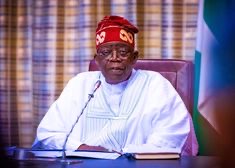
President marks 27 years of unbroken civilian rule with record security budget, power sector reforms, and national honours for June 12 heroes
President Bola Ahmed Tinubu on Friday declared that Nigeria’s current generation bears the historic duty of securing economic freedom, as the nation marked its 27th consecutive year of democratic governance since the return to civilian rule on 29 May 1999.
Speaking in a nationally broadcast Democracy Day address, Tinubu drew a deliberate generational arc — from the founding fathers who won independence, through the June 12 generation that fought military dictatorship for political freedom, to the present, which he charged with delivering prosperity to ordinary Nigerians.
“Democracy must be felt in the pocket,” he said, in what became one of the address’s clearest declarations of intent.
SECURITY: ULTIMATUM AND A RECORD BUDGET
The President’s tone on security was simultaneously sombre and combative. He acknowledged that this year’s Democracy Day was dampened by the recent abduction of children in Oyo and Borno States, expressing hope for their safe return, but stopped short of offering a timeline or operational details.
On the offensive, Tinubu cited a catalogue of military gains. Terror-related deaths, he said, have fallen by 81 per cent since 2015, with over 13,000 terrorists neutralised in the past year alone. A precision strike was also credited with degrading the Islamic State West Africa Province’s (ISWAP) command centre in Arege, Borno State, following joint training with the United States, France, and other European allies.
The government’s 2026 budget commits ₦5.41 trillion to defence and security — the largest such allocation in Nigeria’s history — and has already activated the recruitment of over 50,000 new police officers alongside thousands of military personnel.
On rehabilitation, Operation Safe Corridor has received over 124,000 fighters and their dependents since 2023. However, Tinubu drew a sharp line for those yet to come forward.
“Surrender or face the full force of the Nigerian State,” he warned. “These windows of surrender will not remain open forever. No mercy will be shown to those who trade in the blood of Nigerians.”
ECONOMY: PROGRESS CLAIMED, HARDSHIP ACKNOWLEDGED
The President mounted a defence of his administration’s economic reform programme, framing the pain of the past three years as unavoidable medicine for deeply strained public finances inherited in 2023.
He pointed to rising federation revenues, a 21 per cent growth in non-oil exports, the certification of over 1,000 SMEs for export, and the deployment of 10,000 tractors under the National Agricultural Development Fund as evidence of structural progress. Increased domestic refining capacity, he added, was reducing Nigeria’s reliance on imported petroleum products.
Yet Tinubu was candid about the gap between policy and lived experience. “Many Nigerians still face economic hardship,” he conceded, pledging continued focus on reducing inflation, expanding food production, and creating jobs.
On the power sector, he outlined the scale of what his administration inherited — a grid transmitting less than it generated, distributing less than it transmitted, and collecting revenue far below what was needed to sustain itself, against a metering deficit of over four million connections. In response, the President cited the Electricity Act, which now grants states authority to generate, transmit, and distribute power, and announced that a ₦4 trillion bond had been authorised to settle verified legacy debts. The Rural Electrification Agency, backed by the World Bank and African Development Bank, has also extended off-grid and mini-grid power to underserved communities, hospitals, markets, and universities.
LOCAL GOVERNMENT AND GRASSROOTS GOVERNANCE:
In a notable policy link, Tinubu tied the country’s security challenges directly to the historic collapse of local government administration, and restated his administration’s commitment to full financial autonomy for all 774 local councils.
“The insecurity we are addressing is partly due to the collapse of grassroots governance,” he said.
HONOURS, ELECTIONS, AND INSTITUTIONAL GUARDRAILS:
With governorship elections approaching in Ekiti and Osun States, Tinubu issued a firm directive to the Independent National Electoral Commission and security agencies to guarantee peaceful and credible polls. “Democracy fails when citizens doubt the process,” he stated.
The President also named four institutions as the republic’s essential guardrails — the National Assembly, the Judiciary, the Press, and Civil Society — and extended an unusually direct invitation to critics: “Criticise me, disagree with me, but never stop believing in Nigeria.”
To Nigeria’s youth, particularly those tempted by the “Japa” wave of emigration, Tinubu was direct: “Build here, code here, work here, and vote here. Every great nation was built by those who stayed to solve problems, not by those who abandoned ship.”
In a ceremony befitting the day’s historical weight, Tinubu announced national awards for 33 Nigerians — journalists, activists, lawyers, and military figures — who endured persecution, exile, incarceration, and solitary confinement during the military era. Recipients include Barrister Ayoka Lawani, Richard Akinnola, Dr Joe Okei-Odumakin, Major-General Ishola Williams (rtd), and others. The full honours list is to be published in the coming days.
The Federal Government also approved the renaming and revitalisation of the completed Institute of Petroleum Studies in Kaduna as the General Shehu Musa Yar’Adua University of Geological Sciences and Engineering Technology, in honour of the late General who was described as an architect of modern democratic Nigeria.
CLOSING: “WE DO NOT BREAK”
Tinubu closed his address with the speech’s defining refrain, invoking the spirit of the June 12 struggle and the resilience that he argued defines the Nigerian character.
“The road ahead is steep. But June 12 reminds us: Nigerians do not break. We bend, we bleed, but we do not break.”
The address, broadcast nationally on Friday, 12 June 2026, marked Democracy Day — commemorating the anniversary of the historic 12 June 1993 presidential election won by the late Chief MKO Abiola, widely regarded as the freest election in Nigeria’s history.
Ene Mary McDickson
Discussion0
No comments yet
Be the first to share your thoughts on this story.