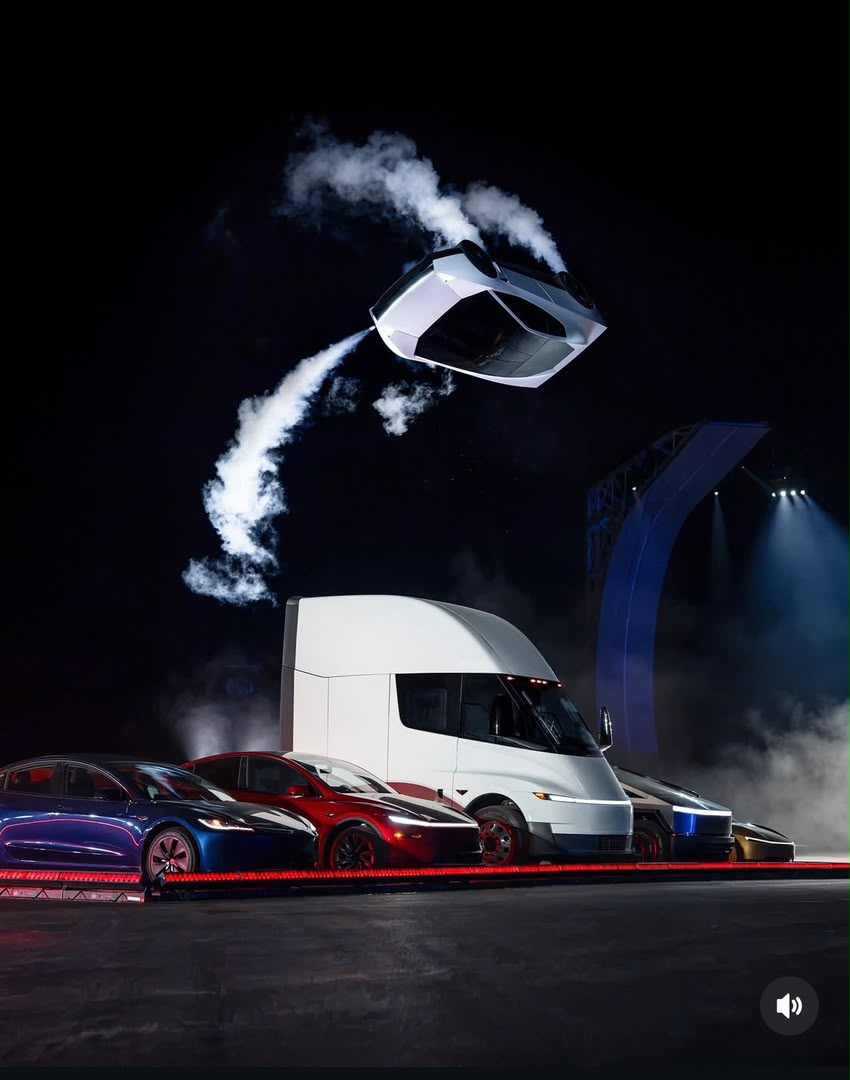
Tesla Chief Executive Elon Musk has unveiled a redesigned version of the company’s long-delayed Roadster electric sports car, demonstrating a prototype that can perform brief aerial manoeuvres using rocket-style thrusters developed in collaboration with SpaceX.
The unveiling took place on Thursday, October 15, at a SpaceX test facility in McGregor, Texas, nearly nine years after Tesla first presented the second-generation Roadster. The event showcased the vehicle’s unusual capabilities, including driving upside down along a ramp, flipping in mid-air and landing back on the pavement.
During the demonstration, the car used a suction system to remain attached to the inverted ramp before employing cold-gas thrusters powered by compressed air to execute its aerial manoeuvres. It subsequently jumped over a line of Tesla vehicles, including the Cybercab, Cybertruck, Semi, Model Y and Model 3.
The prototype operated without a driver during the stunts, with Musk acknowledging the risks involved before the demonstration. Tesla vehicle engineering chief Lars Moravy said the system incorporated 10 thrusters connected to a compressed-air supply.
Tesla also demonstrated the Roadster’s acceleration, claiming it could travel from zero to 60 miles per hour in less than a second. The company’s website lists a top speed exceeding 230 miles per hour, although these figures remain manufacturer claims rather than independently verified production-vehicle performance.
Tesla plans to offer the Roadster in three versions: Performance, Thrust and Rocket. The Performance and Thrust variants are designed to accommodate two occupants, while the Rocket version is a single-seater featuring a full flight system and is available by invitation only.
According to reports by TechCrunch and Reuters, Tesla is accepting reservations requiring deposits of $50,000 for the Performance version and $250,000 for the Thrust model. The company has not announced a confirmed final purchase price for the new vehicle.
Musk said production would begin in 2028, but the proposed timeline remains subject to development and manufacturing progress. Tesla first unveiled the second-generation Roadster in November 2017 and initially promised deliveries in 2020. The project has since experienced repeated delays.
Despite the spectacle, significant questions remain about the vehicle’s practicality and regulatory status. Tesla has yet to establish that the thruster-equipped version has the necessary approvals to operate as a road vehicle and aircraft. The demonstration also did not establish how long the vehicle could remain airborne or provide comprehensive public safety and certification data.
The unveiling comes as Tesla increasingly emphasises artificial intelligence, autonomous driving and robotics alongside its electric-vehicle business. Analysts have described the Roadster as a showcase of the company’s engineering ambitions, while questioning its immediate financial significance.
Tesla shares rose in pre-market trading on Friday, October 16, following the unveiling, but the initial gains did not necessarily translate into a stronger closing performance. The company is scheduled to report its third-quarter financial results on October 21, an event expected to provide investors with a clearer assessment of its business performance.
For now, the Roadster remains an ambitious demonstration of electric-vehicle and aerospace technology. Whether Tesla can translate its aerial stunts into a commercially available vehicle by 2028 will depend on further engineering development, safety requirements and regulatory approval.
Discussion0
No comments yet
Be the first to share your thoughts on this story.