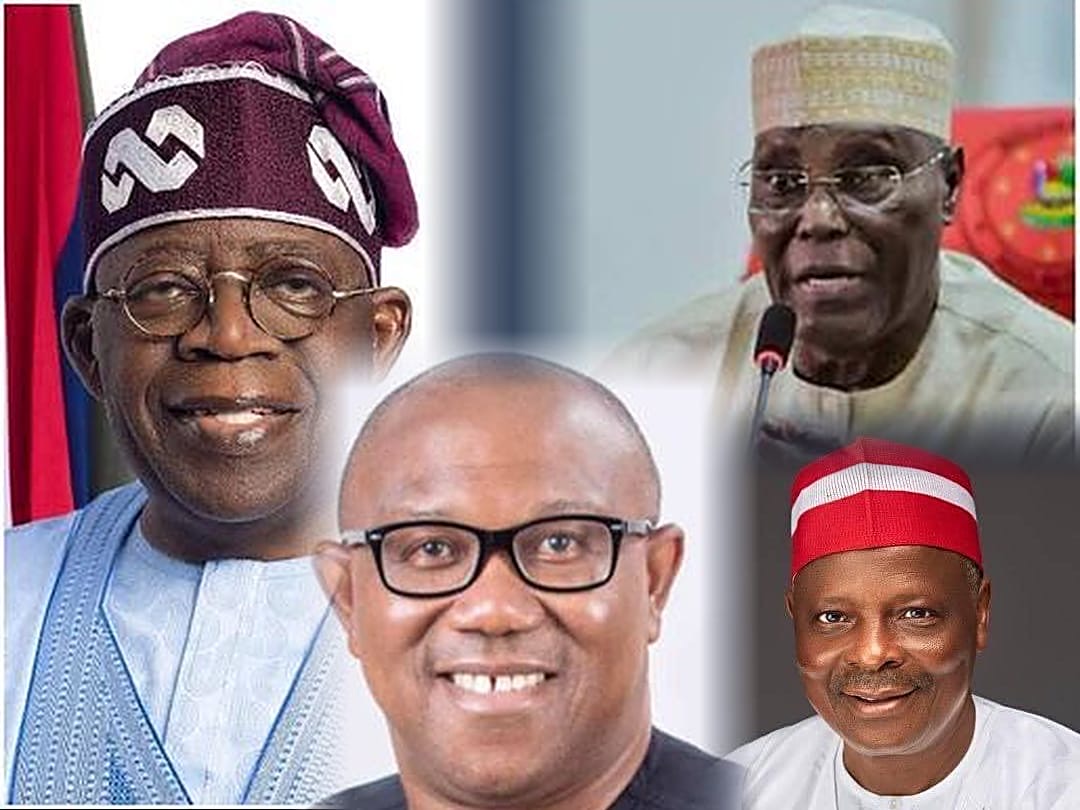
The North is emerging as a major battleground ahead of Nigeria’s January 16, 2027 presidential election, with President Bola Tinubu, former Vice-President Atiku Abubakar and the Peter Obi–Rabiu Kwankwaso ticket seeking to secure support across a region that accounted for a substantial share of the votes cast for the leading candidates in 2023.
The Independent National Electoral Commission (INEC) puts Nigeria’s registered voter population at 103,428,715, an increase of approximately 10.66 per cent from 93,469,008 in 2023. The 19 northern states account for 54,282,630 registered voters, while the broader northern region, including the Federal Capital Territory (FCT), has 56,014,673.
The figures place the North at the centre of the electoral calculations of the major parties, particularly the ruling All Progressives Congress (APC), the African Democratic Congress (ADC) and the Nigeria Democratic Congress (NDC).
According to the 2023 presidential election results, Tinubu secured 8,794,726 votes nationwide, including approximately 5.51 million from the 19 northern states. That represented about 62.6 per cent of his national total.
Despite that contribution, Tinubu won only seven of the 19 northern states. Atiku won nine, Peter Obi won two, while Kwankwaso won Kano State.
Tinubu nevertheless recorded more votes across the 19 states than Atiku, whose northern tally was approximately 5.06 million. The results illustrate the difference between winning individual states and accumulating enough votes across a region to influence the national outcome.
Tinubu’s national margin over Atiku in 2023 was 1,810,206 votes. A hypothetical 20 per cent reduction in Tinubu’s northern votes, without compensating gains elsewhere, would amount to approximately 1.10 million votes.
Such a reduction would exceed 60 per cent of his previous national margin over Atiku. The calculation is illustrative rather than predictive, as the outcome of the next election will depend on voter preferences, turnout, party mobilisation and other factors.
Campaigns intensify ahead of 2027
Political mobilisation is already gathering pace as the major contenders seek to consolidate their support bases.
The APC has begun organising its re-election campaign around Tinubu’s incumbency and its established political structures. The ADC is mobilising behind Atiku, while the NDC is preparing to campaign with Obi as its presidential candidate and Kwankwaso as his running mate.
The NDC announced plans to inaugurate its presidential campaign council on October 20, subject to any subsequent changes.
Support groups backing Tinubu have also intensified their activities in the North. On October 12, a group operating as Arewa for Asiwaju, led by former Kano State Governor Ibrahim Shekarau, reportedly declared support for the president following a visit to Vice-President Kashim Shettima at the Presidential Villa.
The Tinubu Again Movement, promoted by Minister of State for Defence Bello Matawalle, is another part of the mobilisation effort. Senator Abdulaziz Yari has also been associated with Tinubu’s re-election campaign in Zamfara State.
These endorsements provide the president’s campaign with additional political networks, but their electoral impact will depend on whether supporters can translate political declarations into votes.
The contest also comes amid debates over the distribution of federal appointments, insecurity, economic pressures and the performance of the Tinubu administration. These issues could influence how voters assess the incumbent, although their impact will vary across states and communities.
North-West: the largest electoral bloc
The North-West, comprising Kano, Kaduna, Katsina, Jigawa, Zamfara, Sokoto and Kebbi, has 25,083,411 registered voters, making it the largest geopolitical zone by voter population.
In 2023, Tinubu secured approximately 2.65 million votes from the zone but won only Jigawa and Zamfara. Atiku carried Kaduna, Katsina, Sokoto and Kebbi, while Kwankwaso won Kano.
The zone’s importance is expected to increase as the parties seek to consolidate their existing support and attract voters who backed rival candidates in the previous election.
Kano presents one of the most closely watched contests.
The state has 6,570,276 registered voters, the second-largest number nationally after Lagos. Its register has increased by 648,906 since 2023, the largest absolute gain recorded by any state.
In the 2023 presidential election, Kwankwaso received 997,279 votes in Kano on the platform of the New Nigeria Peoples Party (NNPP). Tinubu polled 517,341 votes, Atiku received 131,716, and Obi secured 28,513.
The political landscape has since changed. Kano Governor Abba Kabir Yusuf, who was elected on the NNPP platform, defected to the APC in January 2026.
His departure creates a significant question for the coming election: whether the political structures and supporters associated with the governor will follow him to the APC or remain loyal to Kwankwaso.
The answer could affect the distribution of votes among the three leading presidential contenders. However, the 2023 results cannot be transferred directly to the new contest, as party affiliations, voter preferences and campaign alliances have changed.
Kaduna is another important battleground, with 4,662,640 registered voters.
Atiku won the state in 2023 with 554,360 votes, ahead of Tinubu’s 399,293 and Obi’s 294,494.
The state’s political dynamics are complicated by its ethnic, religious and geographic diversity, alongside competing political networks associated with Governor Uba Sani and former Governor Nasir El-Rufai.
The APC’s control of the state government gives Tinubu an established political structure, while opposition networks could provide Atiku and other challengers with opportunities to compete.
The eventual outcome will depend on how effectively the parties mobilise supporters across the state’s different constituencies.
The wider northern contest
Beyond the North-West, the North-East and North-Central zones will also contribute substantially to the national electoral calculation.
The North-East has 13,965,475 registered voters, up from 12,542,429 in 2023. Atiku won five of the zone’s six states in the last presidential election, while Tinubu won Borno.
Borno remains important to the APC because of its established political structure and the influence of Governor Babagana Zulum and Vice-President Shettima. However, the president’s performance in the state in 2027 will depend on voter turnout, local political dynamics and assessments of the administration’s record.
The North-Central zone, which includes states such as Niger, Kogi, Kwara, Benue, Plateau and Nasarawa, also presents opportunities and challenges for the major contenders.
Its diverse political alignments make it difficult to predict a uniform regional voting pattern. Individual state contests, local alliances and the candidates’ ability to address voters’ concerns are likely to play important roles.
Across the North, insecurity, economic hardship, unemployment and the cost of living are among the issues that could shape voter decisions. The extent to which these concerns influence voting will depend on how voters evaluate the competing parties and their proposed solutions.
Opposition votes and the challenge of alliances
The emergence of the Obi–Kwankwaso ticket introduces another dimension to the contest, particularly in Kano and other states where Kwankwaso has an established political following.
Obi’s performance in 2023 demonstrated an ability to attract substantial support in parts of the country, while Kwankwaso’s nearly one million votes in Kano highlighted his influence in the state.
However, combining the two political followings does not automatically guarantee a corresponding increase in votes. Their supporters may have different political priorities, and the new party platform may not attract every voter who supported either candidate previously.
Atiku also retains considerable northern recognition and demonstrated electoral strength in several states in 2023. His campaign will need to maintain that support while competing with the NDC for voters seeking an alternative to the APC.
For Tinubu, competition between opposition parties could provide an advantage if their candidates draw support from overlapping constituencies. However, the extent of that advantage will depend on the candidates’ appeal, campaign strategies and voter turnout.
The three leading contenders therefore face different challenges: Tinubu must defend the coalition that secured his victory in 2023, Atiku must translate his northern support into a stronger national performance, and Obi and Kwankwaso must demonstrate that their partnership can build a broad and effective electoral coalition.
The numbers behind the contest
The northern voter register provides a clear indication of the region’s importance, but registration figures alone cannot determine the election.
Not every registered voter will cast a ballot, and the distribution of actual votes will depend on turnout, voter registration verification, Permanent Voter Card collection, security and election-day logistics.
The 2027 contest will also be shaped by developments between now and election day, including party organisation, candidate campaigns, alliances and voters’ assessments of the incumbent administration.
For Tinubu, retaining sufficient support across the North could be crucial to protecting the electoral coalition that brought him to power. For Atiku, the region offers an opportunity to build on his previous performance. For Obi and Kwankwaso, it presents a test of whether their partnership can expand beyond existing support bases.
The North is not a single voting bloc, and its voters are unlikely to respond uniformly to any candidate or political message. Its size, diversity and electoral history nevertheless make it central to the presidential race.
With more than 54 million registered voters across its 19 states, the region is positioned to exert substantial influence on the contest.
In 2023, northern votes contributed significantly to Tinubu’s victory. In 2027, how those votes are distributed could prove decisive in determining who becomes Nigeria’s next president.
Discussion1
May God help us to choose wisely in 2027 Amen