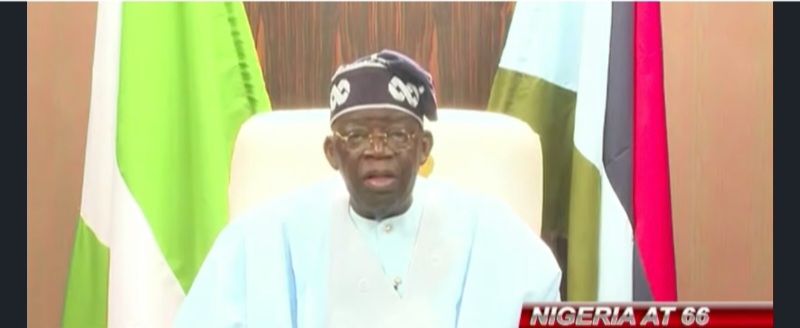
President Bola Ahmed Tinubu has acknowledged the hardship millions of Nigerians have experienced under his administration’s economic reforms, but said the problems confronting the country had accumulated over decades and could not be resolved within four years.
In his Independence Day address on Thursday, marking Nigeria’s 66th anniversary, the President said his administration inherited an economy in deep distress and had to take difficult decisions to address long-standing distortions.
He declared that the period of “emergency economic treatment” was over and that Nigeria had entered an “age of prosperity.”
Using the analogy of a cancer patient, Tinubu said the country needed painful but necessary treatment rather than temporary relief.
“For too long, Nigeria’s leaders chose morphine while praying for a miracle that never came,” he said. “By 2023, poverty was rising, and hope was nearly gone. We had no choice but to act.”
The President acknowledged that the reforms had produced real side effects but rejected suggestions that they were responsible for the underlying weaknesses in the economy.
“We must never confuse the medicine with the disease,” he said. “Our reforms did not create the weaknesses in our economy. They confronted them.”
Tinubu also criticised calls for a return to fuel subsidies, urging Nigerians to resist what he described as the “siren song” of “influential but regressive voices.”
“We must remember why we began this journey and how far we have already come,” he said.
Tinubu Lists Economic Gains
The President cited several indicators which he said showed that the reforms were beginning to produce results.
He said the economy had grown by more than four per cent this year, with both oil and non-oil sectors contributing, while oil theft had declined.
According to him, inflation had fallen substantially from its peak, foreign reserves had been rebuilt and the foreign exchange market had stabilised.
Tinubu also said Nigeria recorded its highest-ever revenue from non-oil exports in 2025, exceeding $6 billion.
The administration has previously highlighted growth, foreign-exchange stability and expanding non-oil activity as evidence of an improving economic outlook.
“We have reached a turning point. The emergency treatment is over. The foundation has been repaired,” Tinubu said.
“Now, our purpose is simple: shared and widespread prosperity.”
Focus Shifts to Cost of Living, Jobs
The President said the next phase of his administration would focus less on correcting macroeconomic distortions and more on reducing the cost of living, expanding production, creating jobs and widening economic opportunities.
He acknowledged that many Nigerians were still struggling with the effects of the reforms.
“We cannot erase in four years what accumulated over generations. But we can change its course,” he said.
“We can build an economy that steadily lifts people out of poverty while ensuring that those who remain vulnerable are not abandoned along the way.”
The address comes against the backdrop of continuing pressure on household budgets following major changes in fuel pricing and the foreign exchange market since Tinubu assumed office in May 2023.
The administration has maintained that the reforms were necessary to correct structural weaknesses in the economy, while promising measures aimed at making the benefits of economic recovery more widely felt. The President has also previously announced measures intended to reduce transportation costs through the National Affordable CNG Transit Programme.
Discussion0
No comments yet
Be the first to share your thoughts on this story.